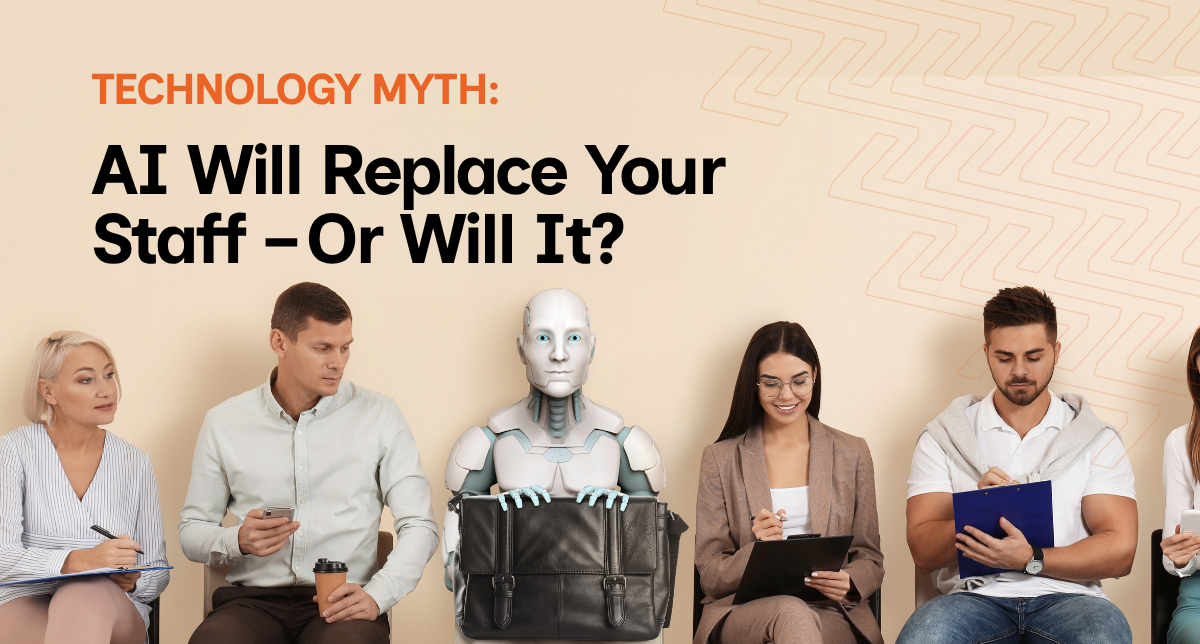
If you read the headlines, you’d think we’re on the verge of a business landscape where machines handle everything from sales to strategy, leaving human employees to fend for themselves. It’s a convenient narrative for a tech blog looking for clicks, but it’s fundamentally detached from the reality of running a sustainable business.
In our work with businesses—whether in Brisbane or across the New England region—the conversation rarely centers on replacement. It centers on a much bigger problem: burnout.
The vast majority of the people we talk to aren't failing because they lack talent. They are failing because they are
drowning in administrative debt. They are spending their best hours chasing paperwork, manually updating CRM fields, and fighting with file
versions.
According to a 2026 report on workforce productivity, the average professional wastes nearly 30% of their working day on repetitive tasks that require zero critical thinking. That isn't a staff problem; it’s a process problem.
AI doesn't need to "replace" your staff. It just needs to take the robot out of the human. When we help a client integrate AI into
their workflow, we aren’t looking for headcount reduction. We’re looking for the hours spent on copy-pasting data or re-formatting reports.
When you remove that friction, you aren’t replacing staff—you’re liberating them to focus on the high-value, high-empathy work that machines
can’t touch.

Think of AI as an industrial-grade lever. It doesn't move the rock for you; it gives you the leverage to move the rock yourself with a fraction of the effort.
The businesses that view AI as a "staff replacement" strategy are usually the ones that miss the point entirely. They view their workforce as a cost center to be minimized. But the businesses that view AI as a "capability expander" treat their workforce as an asset to be amplified.
If your staff is currently tasked with meaningful decision-making, AI helps them make those decisions faster by summarizing data, identifying trends, and drafting the groundwork. You get more out of your people because you’ve stopped asking them to function like data entry software.
There is also a question of security. AI can draft a proposal or summarize a meeting in seconds, but it cannot exercise professional judgment. It cannot hold a conversation with a nervous client or navigate the nuances of a complex local business deal.
As we see in data from recent 2026 cybersecurity research, human verification remains the most critical barrier against systemic failure. AI is prone to "hallucination"—it can confidently state things that are completely untrue. Having a skilled human in the loop isn't just about "keeping someone employed"; it’s about maintaining the integrity of your business operations.
The next time you hear someone say that AI is going to replace your staff, ask them if they’ve ever tried to run a business on pure automation. It’s impossible.
The real question isn't "how do I replace my team with AI?" The real question is: What is the one thing my team hates doing every single week that we could automate today? When you solve that, you don't just save money. You change the culture of your business. You make work more interesting, more efficient, and, ultimately, more profitable.
Before investing in another AI platform, review the technology already supporting the business. A practical technology review often uncovers opportunities to improve productivity, simplify systems and prepare the business for future AI adoption.
ZaheZone’s Technology Health Checks are designed to provide a clear, practical snapshot of a business’s technology environment.
These reviews typically assess:
• Communications systems
• Cyber security posture (SMB1001 aligned)
• Microsoft 365 configuration and licensing
• Overall IT infrastructure
References:
Everyone is talking about AI, but is it really the next technology investment your business needs? Discover why better workflows, connected systems and solid IT foundations should come first.
.png)
Most businesses don’t design their communication systems, they build them over time... A new internet plan. Extra mobile services. A phone system added along the way. Individually, it all makes sense. But over time, we’re seeing more businesses end up with systems that work… just not efficiently. Not because anything is broken, but because no one has stepped back to ask: Does this still make sense for how we operate today? That’s where the hidden cost sits.
Being ‘secure enough’ is no longer enough. SMB1001 gives South East Queensland businesses a practical, tiered path to proving cyber maturity, reducing insurance risk, unlocking contracts, and building trust. This article explains why SMB1001 is fast becoming the new standard for growth-focused SMBs — and how to approach compliance as a business investment, not an IT cost


.png)

At ZaheZone, we take your business growth seriously, which is why we’re with you every step of the way. To discover how we can help you optimize and scale your IT, contact us today.